

Dr. Andrea Adams-Miller Highlights Growing Executive Risk as Cognitive Lapses Trigger Market and Reputational Fallout
FINDLAY, OH, Dec. 30, 2025 (GLOBE NEWSWIRE) -- FINDLAY, OH - December 31, 2025 - -
Dr. Andrea Adams-Miller of The RED Carpet Connection LLC is addressing a growing shift in executive advisory work as organizations increasingly treat discretion, cognitive clarity, and mental containment as leadership risk infrastructure rather than personal development.
Recent events have underscored the financial and reputational stakes. Earlier this year, a prominent technology CEO's offhand remark during a public interview triggered a rapid stock decline and a cascading public-relations crisis within hours. Market analysts and governance experts noted that the incident highlighted how momentary lapses in focus or restraint can destabilize enterprise value, investor confidence, and leadership credibility almost instantly.
Political leaders, corporate executives, and organizational decision-makers now operate under continuous exposure. Every statement, pause, and reaction is subject to scrutiny across traditional media, social platforms, regulatory environments, and AI-driven amplification systems. High-pressure conditions compress decision timelines, heighten emotional arousal, and narrow attention, increasing the likelihood of miscalculation when outcomes carry legal, financial, or reputational consequence.
Neuroscience research helps explain why these breakdowns occur. Studies show that chronic stress disrupts neural systems responsible for judgment, focus, and self-regulation, impairing executive performance precisely when clarity is most required. Under sustained pressure, leaders become more susceptible to reactive behavior and less capable of strategic restraint, a vulnerability that can surface publicly with little warning.
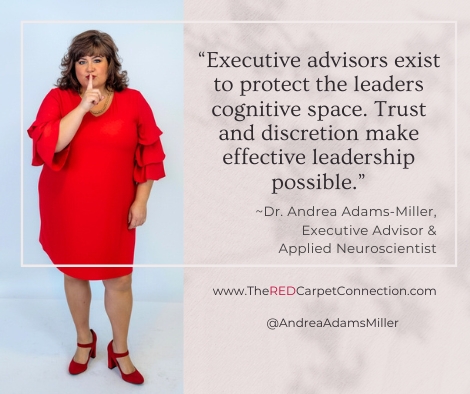
Adams-Miller serves as an executive advisor and applied neuroscientist supporting high-risk leaders whose roles involve legal exposure, public visibility, and significant organizational influence. Her advisory work focuses on cognitive stability, clarity, and containment during periods where leadership errors carry outsized cost. Engagements are conducted privately, without public attribution, and prioritize operational performance rather than visibility or branding.
Peer-reviewed research reinforces the business implications. Neuroscientists have demonstrated that stress shifts cognition away from deliberate, goal-directed decision-making toward habitual responses, even when situations demand flexibility and precision. In leadership contexts, this shift can translate into premature concessions, delayed action, messaging missteps, or avoidable escalation.
More recent findings indicate that stress-related effects on learning, memory, and judgment vary by individual and context, placing leaders at heightened risk during volatility, scrutiny, or crisis. These cognitive effects rarely remain isolated. They ripple across negotiations, teams, stakeholder relations, and organizational culture.
Leadership burnout further compounds exposure. Research links burnout to reduced productivity, increased turnover, and higher healthcare utilization across organizations. For senior leaders, downstream consequences magnify quickly, affecting morale, continuity, and financial performance. Organizational psychologists emphasize that burnout reflects environmental and systemic pressures rather than individual weakness, particularly in high-accountability roles.
In practical application, Adams-Miller's advisory model often engages leaders during moments when hesitation, emotional reactivity, or overexposure could trigger measurable loss. A common scenario involves leaders entering negotiations or public-facing decisions under sustained stakeholder pressure or media scrutiny. Instead of defaulting to reactive messaging or premature disclosure, cognitive containment supports disciplined timing, calibrated response, and strategic silence, often preventing reputational damage or financial fallout before it occurs.
Unlike visibility-driven coaching or consulting models, Adams-Miller's advisory framework operates without testimonials, public case studies, or social proof. Confidentiality functions as an operational requirement rather than a marketing choice. Leaders engage this scope when internal clarity matters more than external optics.
"At senior levels of responsibility, internal clarity becomes a strategic asset," Adams-Miller said. "Protected cognitive space allows leaders to think clearly, recalibrate effectively, and respond with intention rather than impulse."
While individual engagements remain confidential, outcomes reported across advisory work frequently include shortened decision cycles, fewer reactive escalations, and greater consistency during high-pressure negotiations. Leaders often describe clearer prioritization, improved emotional regulation under scrutiny, and increased stability during periods of organizational change, factors closely associated with leadership credibility and operational resilience.
Organizations already recognize the value of discretion in other high-risk domains. Confidential executive searches protect market confidence and internal morale during leadership transitions. That same containment logic is increasingly applied to cognitive performance and executive decision-making as information velocity accelerates and reputational risk intensifies.
Many leaders seeking this advisory scope have previously invested in traditional coaching, therapy, or consulting. The differentiator lies in compression and containment, resolving internal interference efficiently while preserving privacy and operational continuity.
As leadership demands escalate across political, corporate, and organizational environments, discreet neuroscience-informed advisory support continues to expand. For leaders operating under constant exposure, private clarity increasingly determines public stability.
Confidential Briefing Information regarding executive advisory scope is available through The RED Carpet Connection LLC's official website. Inquiries are reviewed based on relevance, capacity, and alignment with high-risk leadership needs.
About Dr. Andrea Adams-Miller
Dr. Andrea Adams-Miller serves as an executive advisor and applied neuroscientist supporting high-risk leaders across political, corporate, and organizational sectors. Her work integrates applied neuroscience, cognitive performance strategy, and executive advisory frameworks focused on clarity, discretion, and sustained focus under pressure.
About The RED Carpet Connection LLC
The RED Carpet Connection LLC operates as a strategic advisory firm supporting executives, founders, political leaders, and public-facing decision-makers. The firm specializes in executive clarity, cognitive performance, and high-stakes decision containment through applied neuroscience and structured advisory frameworks.
Disclaimer: Dr. Andrea Adams-Miller does not provide medical or psychological treatment. Services function as executive advisory and applied neuroscience support focused on cognitive performance, clarity, and focus.
###
For more information about TheREDCarpetConnection.com, LLC, contact the company here:
TheREDCarpetConnection.com, LLC
Dr. Andrea Adams-Miller
419-722-6931
AndreaAdamsMiller@TheREDCarpetConnection.com
8155 Township Road 89, Findlay, OH 45840

Dr. Andrea Adams-Miller
Legal Disclaimer:
EIN Presswire provides this news content "as is" without warranty of any kind. We do not accept any responsibility or liability for the accuracy, content, images, videos, licenses, completeness, legality, or reliability of the information contained in this article. If you have any complaints or copyright issues related to this article, kindly contact the author above.
