

Clootrack VoC study reveals why people singled out brands on Super Bowl Sunday
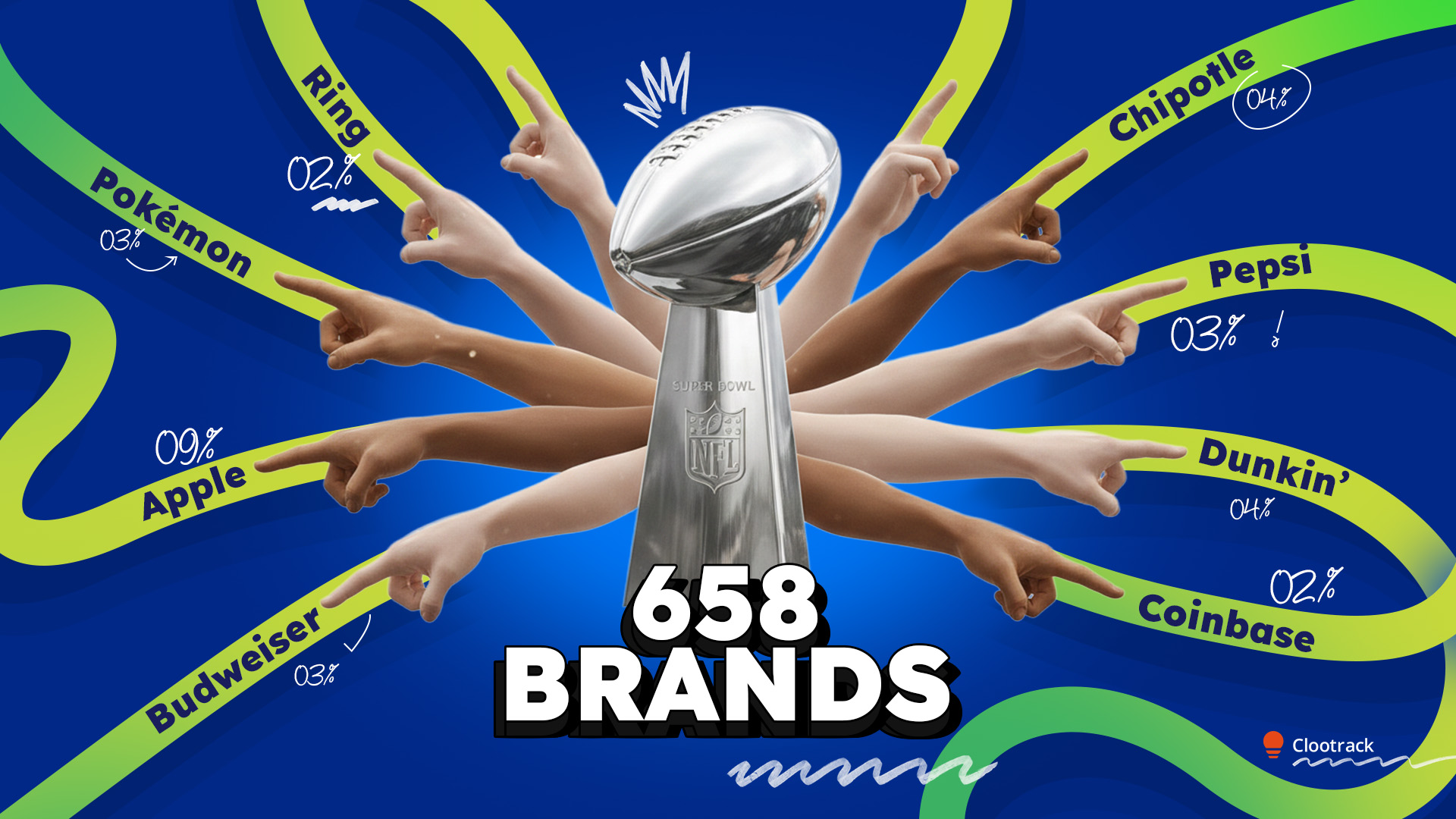
83K Super Bowl posts analyzed in 24 hours
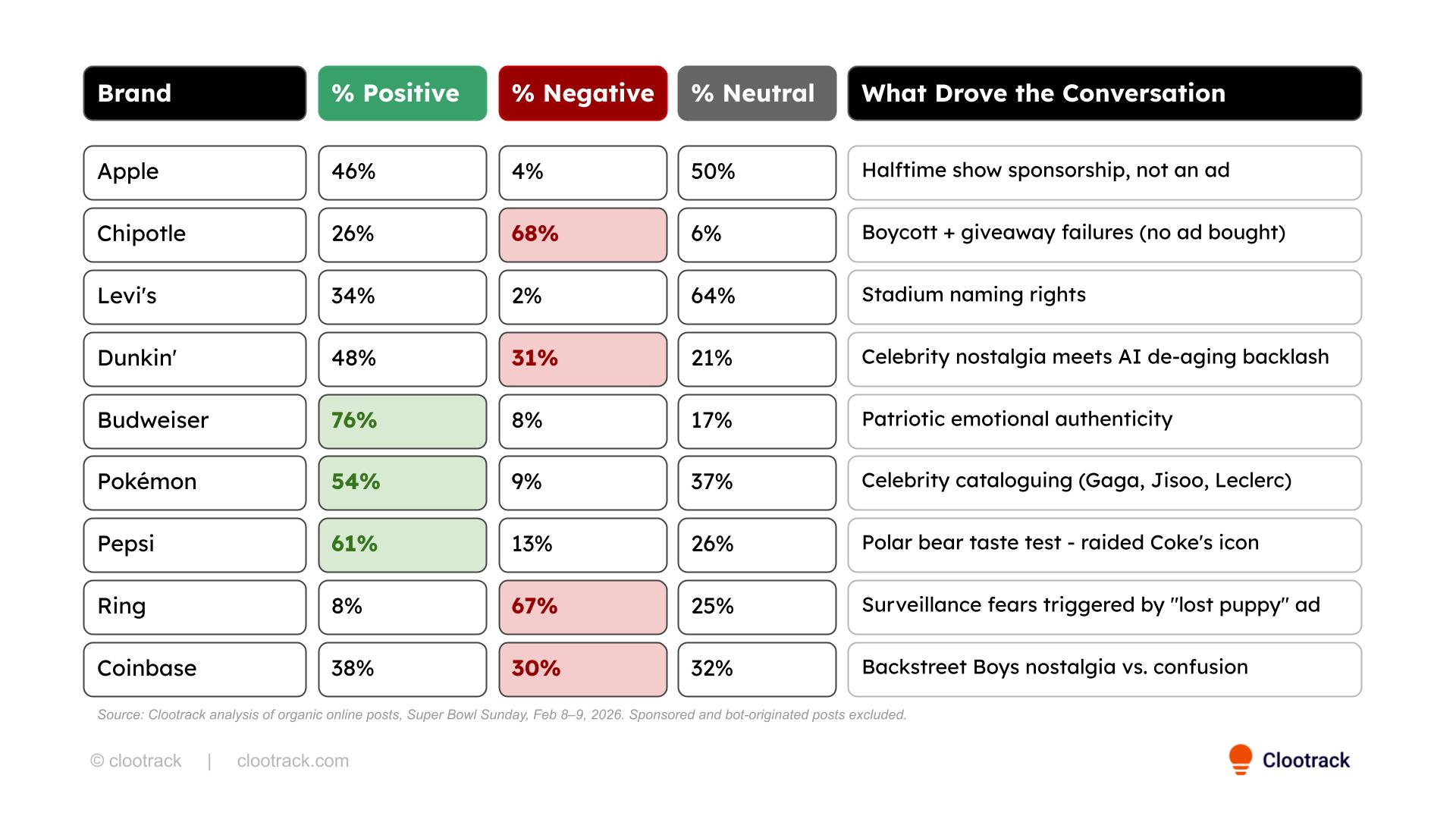
Organic Super Bowl brand sentiment breakdown (% positive, % negative, % neutral)
Clootrack analyzed 83,000 Super Bowl related posts from a 24-hour window around Super Bowl Sunday. From that universe, Clootrack zoomed in on posts that explicitly mentioned brands, and then removed brand-owned, sponsored, and promotional content to retain genuine user conversation. Within that organic, brand-naming set, people referenced 658 brands.
Clootrack is the Voice of Customer analytics platform recognized by OpenAI last year for crossing 100B tokens.
What emerges isn’t an “ad leaderboard.” It’s a clearer map of what makes a brand mention-worthy in real time - the moments that cut through game talk, memes, and hot takes enough for someone to type a brand name on purpose.
The shape of attention: “brand buzz” is wildly uneven
Even within organic, brand-naming conversation, attention concentrates fast:
- Roughly 69% of brands were mentioned very less - long tail
- The top 10 brands captured about 36% of all brand-naming posts.
So yes, the Super Bowl is huge - but the online “name-mention economy” is still a narrow funnel. Most brands flicker. A few linger.
The brands that got named most
The most explicitly named brands each accounted for only a single-digit share of conversation - but they still stood out clearly:
- Apple: ~9%
- Chipotle: ~4%
- Levi’s: ~4%
- Dunkin’: ~4%
- Budweiser: ~3%
- Pokémon: ~3%
- Pepsi: ~3%
- Ring: ~2%
- Coinbase: ~2%
The three reasons people “name names” on Super Bowl Sunday
1) Presence: brands that feel “built into the night” get named more reliably
Two of the biggest drivers of organic brand naming were Event and Venue Mentions and Brand Promotions / Marketing - together they made up about 31% of all organic brand-naming posts.
This kind of conversation tends to be calm and non-combative:
- In Event and Venue Mentions, only about 2% of posts were negative, with the rest mostly neutral-to-positive.
That’s why brands structurally attached to the night (broadcast integration, sponsorship adjacency, venue context) can show up again and again without having to be polarizing. They become part of the Super Bowl “scaffolding,” so they get referenced like fixtures.
What this means: If your goal is reliable, low-risk mentions, event attachment is the most consistent route.
2) Emotion: brands get named when the feeling is easy to repeat
Some themes were almost pure “endorsement energy”:
- Brand Loyalty and Affection: ~93% positive
- Emotional and Heartfelt Reactions: ~91% positive
- Excitement and Anticipation: ~75% positive
That matters because people don’t just “like” something privately on Super Bowl Sunday - they narrate it. When the emotion is legible in one sentence (“that was wholesome,” “that got me,” “I loved that”), the brand name travels with it.
You can see this pattern in brands like Budweiser, whose organic posts skewed heavily positive (about 76% positive), with relatively low negativity.
What this means: Not all “great ads” create brand naming - but simple emotions do. The more instantly explainable the feeling, the more likely the brand name gets typed.
3) Friction: the fastest way to be named is to create a problem people share
The most negative conversation didn’t look like “ad reviews.” It looked like friction: disappointment, controversy, and “this didn’t work.”
Across the dataset, the most lopsided themes were:
- Critiques and Negative Feedback: ~76% negative
- Technical and Quality Issues: ~74% negative
- Controversial Messaging and Themes: ~69% negative
Two brands illustrate two different kinds of friction:
Chipotle shows “activation friction”:
- Roughly 68% negative sentiment.
- Its posts clustered most in Critiques and Technical/Quality Issues - a classic signature of promos and participation mechanics that people experience as unfair, confusing, or broken.
Ring shows “trust friction”:
- Roughly 67% negative sentiment.
- A large share of Ring’s conversation fell under Controversial Messaging and Themes (about 44% of Ring posts), the kind of reaction that turns into debate about privacy, surveillance, or social boundaries.
What this means: Super Bowl is an ad event, but attention isn’t always applause. The moment a campaign behaves like a product experience (codes, redemption, participation), or touches a cultural nerve (privacy, trust), it can spike brand naming - often with negative momentum.
One more signal: 2026 audiences are quicker to judge “vibe” and authenticity
Across the board, organic sentiment wasn’t uniformly harsh:
- About 40% positive
- About 35% neutral
- About 25% negative
But the pattern of negativity is telling: it clusters in “creepy / off / why would they do that?” reactions and in execution friction. Dunkin’, for example, drew a more divided reaction: while many posts were positive, a sizable share criticized the spot for feeling “uncanny” and inauthentic - with viewers specifically calling out the AI/de-aging vibe and saying it came off creepy or weird rather than funny.
What this means: In 2026, people don’t only judge what a brand says - they judge how it feels, how it’s made, and whether it crosses a line.
The “so what” for leadership teams
Your dataset is useful because it turns Super Bowl talk into operational takeaways. “Buzz” isn’t one thing; it’s three, and each has a different owner:
- Presence-buzz (event attachment, venue context)
Owned by: partnerships + brand strategy
- Emotion-buzz (nostalgia, warmth, delight)
Owned by: creative + brand storytelling
- Friction-buzz (promo failures, controversy, trust backlash)
Owned by: CX/product activation + social response + trust/legal
Super Bowl Sunday is about football - and it’s also about advertising. But online, the brands that get explicitly named aren’t simply the ones that showed up. They’re the ones that became part of the night’s structure, part of the night’s feeling, or part of the night’s argument.
That’s what “mention-worthy” looks like now - and it’s a sharper measure than applause.
Corporate Communications
Clootrack Software Labs Inc
email us here
Legal Disclaimer:
EIN Presswire provides this news content "as is" without warranty of any kind. We do not accept any responsibility or liability for the accuracy, content, images, videos, licenses, completeness, legality, or reliability of the information contained in this article. If you have any complaints or copyright issues related to this article, kindly contact the author above.
