

Get your fresh news on advertising in the world
Provided by AGP
CableTV.com Survey Finds 52.7% of Americans Expect TV Mergers to Raise Monthly Bills

CableTV.com Logo
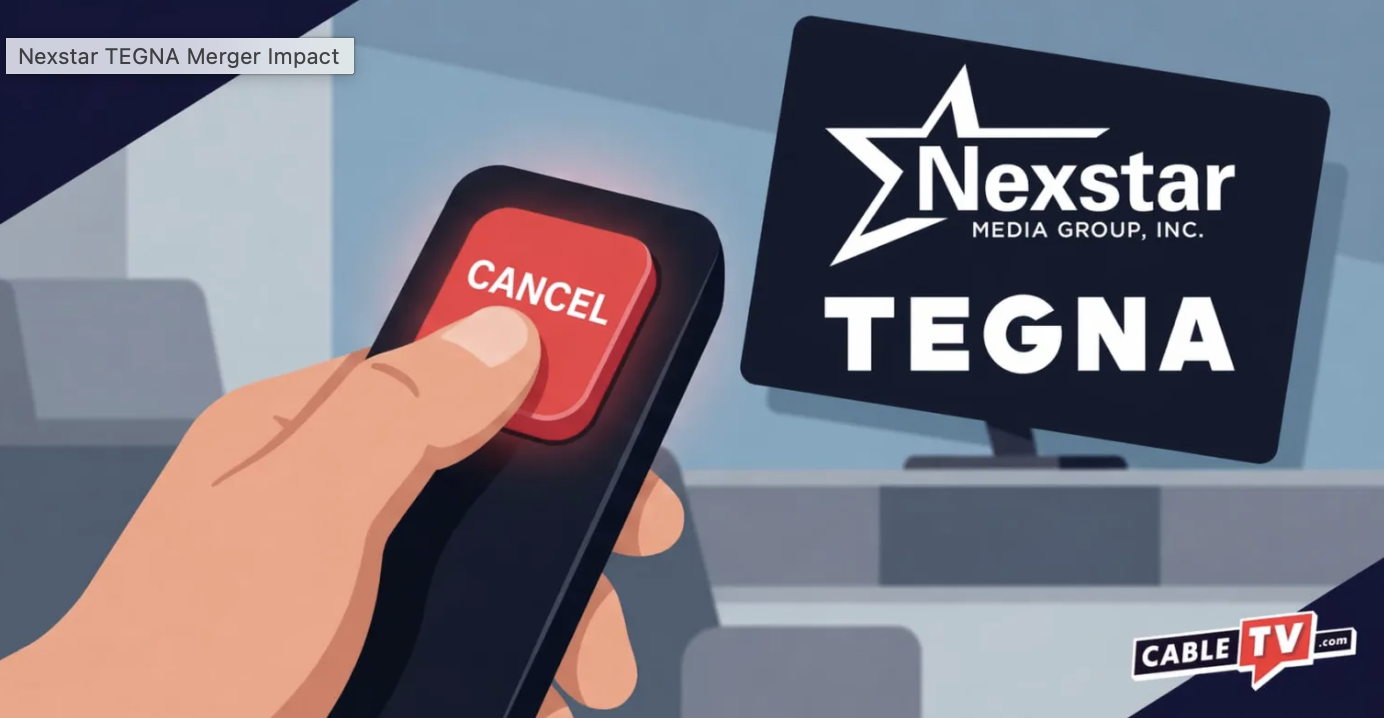
This corporate tug-of-war is exactly why 52.7% of Americans predict these mergers will raise their monthly bills.
New CableTV.com analysis connects the Nexstar-TEGNA merger fight to consumer price sensitivity, local-channel blackouts, and trust in local news outlets.
DRAPER, UT, UNITED STATES, May 4, 2026 /EINPresswire.com/ -- CableTV.com has released new consumer findings showing that Americans are closely watching how television-industry consolidation could affect household budgets, local-channel access, and confidence in local news. The analysis, published after a federal judge temporarily blocked integration of the Nexstar-TEGNA merger while antitrust litigation proceeds, found that 52.7% of Americans predict television mergers will raise monthly bills.The recent findings add a consumer perspective to a fast-moving broadcast dispute involving ownership scale, retransmission fees, local journalism, and access to major network programming. CableTV.com’s report examines the proposed combination through the lens of everyday viewers, highlighting how ownership changes at the station level can move through the television ecosystem and eventually appear in cable, satellite, and live TV streaming bills.
The report also shows that consumers are not viewing the potential of rising bills as an abstract industry issue. More than 56% of consumers surveyed said they would change or cancel their service if a monthly bill increased by up to $20, indicating little to no tolerance for additional costs tied to carriage negotiations, broadcaster leverage, or distributor fee increases. For many households, the central issue is whether local television remains affordable, accessible, and locally relevant as major station groups expand.
CableTV.com’s consumer data does not determine the legal merits of the case, but it adds public-opinion context to concerns raised in court. The report shows that viewers connect large broadcast deals with household costs and service reliability, even when many consumers remain unfamiliar with the ownership structures behind local stations. Nearly half of Americans were unaware of the latest $6.2 billion broadcast deal, even as the transaction could reshape ownership of local television stations across the country.
That awareness gap is significant because local broadcast stations serve as the foundation for news, weather, sports, emergency information, and network programming in many communities. Viewers may recognize station call letters, anchors, weather teams, and sports coverage, but a limited number of consumers track which parent companies own those stations or how ownership changes can affect negotiations with TV providers.
CableTV.com’s findings show that the business of local television often remains invisible until a bill increases or a channel disappears. Broadcast stations negotiate retransmission-consent fees with cable, satellite, and live TV streaming distributors. When those negotiations become contentious, fees can increase, or channels can be removed temporarily from a provider lineup, causing unexpected viewer frustration.
Channel blackouts are another key concern in the report. CableTV.com found that 22.1% of viewers reported losing access to a local TV channel in the past two years because of a provider dispute. Those blackouts can interrupt access to local news, severe-weather updates, emergency information, syndicated programming, prime-time network shows, and live sports. The report connects that frustration to consolidation concerns because larger station groups may have more leverage during retransmission negotiations.
Local news trust gives the merger debate an additional layer of importance. CableTV.com found that 81.1% of viewers trust their local TV station to cover community issues fairly, including 25.4% who trust local stations a great deal and 55.7% who trust them a fair amount. The report suggests that this trust could be vulnerable if consolidation reduces the local identity of stations. Judge Nunley noted that Nexstar has an established track record of consolidating newsrooms when it owns more than one station in a designated market area.
CableTV.com also uncovered that viewer loyalty may significantly decline if local stations lose familiar talent or community presence. The survey showed that 44.3% of viewers would defect if a national owner reduced local talent, with 33.5% watching less often and 10.8% stopping entirely. Anchors, reporters, meteorologists, sports journalists, and community correspondents often function as the human connection between a station and its audience.
The report includes another consumer-education finding: many Americans misunderstand how local broadcast access works. The survey found that 16.7% of Americans mistakenly believe a paid subscription is always required to watch local TV, while 9.8% think local channels are available only through cable or streaming services. In many areas, viewers with a reliable broadcast signal can receive local stations through an over-the-air antenna after a one-time equipment purchase.
CableTV.com’s findings point to several implications for broadcasters, distributors, regulators, and consumers. Broadcasters pursuing scale may need to demonstrate that consolidation will not weaken local newsrooms, reduce viewpoint diversity, or create excessive negotiating leverage. Distributors may need to explain more clearly how retransmission fees affect customer bills and why carriage disputes lead to blackouts. Consumers may benefit from understanding who owns local stations, how local channels reach paid TV packages, and which free or lower-cost options exist in a given market.
As litigation continues, the Nexstar-TEGNA case will remain a significant test of how courts, regulators, broadcasters, distributors, and the public define competition in local television. CableTV.com’s survey does not resolve the competing claims, but it shows that consumers are already concerned about the practical outcomes. The data makes one conclusion clear: as local television ownership becomes more concentrated, viewers will measure the results not by corporate scale, but by affordability, access, trust, and the continued strength of local news.
Craig Stirland
CableTV.com
+1 801-708-0318
email us here
Visit us on social media:
LinkedIn
Instagram
Facebook
YouTube
TikTok
X
Legal Disclaimer:
EIN Presswire provides this news content "as is" without warranty of any kind. We do not accept any responsibility or liability for the accuracy, content, images, videos, licenses, completeness, legality, or reliability of the information contained in this article. If you have any complaints or copyright issues related to this article, kindly contact the author above.
